Blog: Protecting children or protecting profits? The journey to restrict less healthy adverts
by Chloe Higham-Smith | 16 December, 2025 10:41 am
In this blog, we unpack the long journey to restricting less healthy food and drink adverts on TV and online. Whilst the finish line is in sight for 2026, questions have been raised if the updated legislation will truly protect children’s health.
Food marketing specifically targets children and young people through a diverse range of techniques designed to attract their attention, shape their preferences and brand loyalty [1]. Research suggests exposure to less healthy food marketing has been shown to increase children’s food intake and their overall preference for less healthy products [2].
The advertising restrictions for less healthy food and drink marketing on TV and online were first announced as part of the government’s 2020 obesity strategy[1], to block less healthy adverts on TV before 9pm, and a total online ban of less healthy products, which applies to social media, influencer promotions, video platforms and search engines. Products are classified as less healthy or healthy using the Nutrient Profile Model[2] (NPM), which scores foods based on the amount of sugar, salt, and saturated fat versus fibre, protein, fruit, vegetables, and nuts. Points are assigned for both groups, and the final score determines whether a product is classed as high or low in nutrients of concern.
Timeline of the legislation: 2019-2026
2019: Government publish early consultation/impact assessment on restricting promotions by price and place, and advertising of high fat, alt and/or sugar (HFSS) food and drink [3].
April 2022: Health and Care Act 2022 received Royal Assent (This is when the British monarch formally agrees to make the bill into an Act of Parliament).
December 2022: Secondary legislation Communications Act 2003 Regulations 2022 is laid, postponing the implementation date from 1st January 2023 to 1st October 2025. Between 2022-2023, the Government runs secondary legislation consultations on which foods are in scope, how adverts are regulated, scope for online / IPTV, etc) [4].
December 2024: The final rules are published in Advertising (Less Healthy Food Definitions and Exemptions) Regulations 2024, setting out which products are covered and how the legislation will work in practice [5].
June 2025: The government lays Communications Act 2003 Regulations 2025, changing the legal commencement date from 1st October 2025 to 5th January 2026, to provide time to consult on and lay further regulations that will explicitly exempt brand advertising from the restrictions. The Advertising Standards Authority (ASA) published draft guidance in December 2023 outlining how it would apply the restrictions, in line with the Government’s policy intention that brand advertising would be out of scope. A short consultation ran from 16 July to 6 August 2025, and the updated legislation adopted a much broader definition of “brand” than previously consulted on [6].
January 2026: The restrictions are scheduled to come into full legal effect UK-wide: adverts for in-scope “less healthy” foods and drinks will be banned on broadcast TV before the 9pm watershed and banned online paid advertising at all times.
Protecting children or profits?
Whilst we are pleased to see this long-awaited policy finally implemented, industry lobbying [7] has yet again resulted in the government diluting a robust policy, at the expense of protecting children’s health. Brand advertising being exempt from the redrafted legislation means brands and “brands of ranges of products”, (e.g. both Cadbury as a brand and Cadbury Dairy Milk as a product range) generic products treated as specific items and products whether brand and product name are the same, (e.g. Mars, Coca-Cola), can still be advertised. See image below for an example of how the loopholes in the legislation would mean less healthy food marketing would still be permitted.
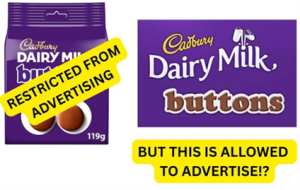 [3]
[3]
Image: Fran Bernhardt
The Government argues the rules only formalise the original intention to exclude pure brand advertising, however, the Advertising Standards Authority (ASA) initially agreed with public health bodies, including the Obesity Health Alliance, that brand adverts could fall within scope of the legislation, which incited strong pushback from industry.
However, a recent study found that brand-only food adverts increase children’s energy intake to a similar extent to product adverts [8]. Ensuring advertising restrictions are robust, enforceable and free from loopholes is essential if we are serious about creating healthier environments that prioritise children’s health – not corporate interests. As part of Food Active’s policy calls, we call on the government to deliver on its promise to create the ‘healthiest generation of children ever’ and adequately protect infants, children and young people from the marketing and advertising of less healthy food and drink.
Dr Robin Ireland, Director of Research at Food Active:
“Whilst even these limited restrictions on less healthy food and drink marketing are to be welcomed, it should be asked why they have taken so long to introduce and why they are not more wide-ranging. If we accept that food and drink marketing impacts on children’s health, we should be making a much more serious attempt to control this marketing”.
[1] Soares Guimaraes, J., Pritchard, M., Sabir, S., Vanderlee, L., Ramsay, T., Elliott, C., & Potvin Kent, M. (2025). The power of product: how food advertising affects children’s perceptions of child and non-child targeted food advertising?. BMC Public Health, 25(1), 3167.
[2] Boyland, E., Muc, M., Coates, A., Ells, L., Halford, J. C., Hill, Z., … & Jones, A. (2025). Food marketing, eating and health outcomes in children and adults: a systematic review and meta-analysis. British Journal of Nutrition, 133(6), 781-805.
[3] Department for Health and Social Care (2024). Less healthy food and drink: advertising and promotions restrictions [online] Available at: Less healthy food or drink: advertising and promotions restrictions – GOV.UK
[4] Department for Health and Social Care (2024). Consultation outcome. Introducing further advertising restrictions on TV and online for products high in fat, salt or sugar: government response to consultation on secondary legislation [online] Available at: Introducing further advertising restrictions on TV and online for products high in fat, salt or sugar: government response to consultation on secondary legislation – GOV.UK
[5] Department for Health and Social Care 2025). Information about regulations restricting the advertising and promotion of less healthy food or drink, also known as foods high in fat, salt or sugar [online] Available at: Less healthy food or drink: advertising and promotions restrictions – GOV.UK
[6] Legislation.gov.uk (2025). The Advertising (Less Healthy Food and Drink) (Brand Advertising Exemption) Regulations 2025 [online] Available at: The Advertising (Less Healthy Food and Drink) (Brand Advertising Exemption) Regulations 2025
[7] The King’s Fund (2025). A prevention revolution – or another missed opportunity? [online] Available at: A Prevention Revolution Or Another Missed Opportunity? | The King’s Fund
[8] 1409foodadvertisingchildrenabstract.pdf – Google Drive
- government’s 2020 obesity strategy: https://www.gov.uk/government/publications/tackling-obesity-government-strategy
- Nutrient Profile Model: https://assets.publishing.service.gov.uk/media/5a7cdac7e5274a2c9a484867/dh_123492.pdf
- [Image]: https://foodactive.org.uk/wp-content/uploads/2025/12/Picture1_cadbury.png
Source URL: https://foodactive.org.uk/blog-protecting-children-or-protecting-profits-the-journey-to-restrict-less-healthy-adverts/