

06 Nov 2026 Guest blog: Advocating for a healthier, lower-sugar childhood
To mark sugar awareness week, we hear from Zoe Davies, Senior Nutrition Projects Officer at Action on Salt and Sugar, about how food industry marketing and the wider food environment shape children’s sugar consumption from infancy through to adolescence, and why stronger action is needed to create healthier food environments.
Taste palettes and dietary habits begin early in life and can shape health for years to come. While parents and carers play an important role in what children eat, children are exposed to high sugar products throughout their food environment, from baby foods and breakfast cereals to social media advertising and fast-food promotions.
This Sugar Awareness Week 2026, we’re exploring how sugar begins in infancy and continues through childhood, and what can be done to create healthier food environments. With childhood obesity rates increasing, now, more than ever, is the time for action.
How nutrition claims and voluntary policies shape early years
Babies and young children should consume as little free sugars as possible, however the commercial food environment often makes this difficult.
Until recently, regulation around baby foods has been minimal, but last year, the government introduced official Commercial Baby Food guidelines. These advise against added sugars in baby meals, snacks and drinks and dissuade misleading, dishonest or exaggerated marketing claims.
This guidance was long overdue. The Broken Plate Report revealed 74% of infant snacks contain ‘high’ or ‘medium’ levels of total sugars. Yet, despite this, products carry an average of five positive nutrition claims, creating the impression they are entirely healthy choices for young children. Sold in dedicated baby-food aisles, many carry claims such as “supports nutrition” and “no nasties”, creating a health-halo-effect that can make them appear healthier than they really are.
Notably, two-thirds of products marketed with a “no added sugar” claim were still found to contain high levels of total sugars, largely due to the use of fruit purees. These purees are a source of free sugars and regular exposure to sweet foods early in life may help shape preferences for sweeter tastes while increasing the risk of dental decay and other diet-related illnesses.
Through marketing and packaging claims, the food industry can shape children’s dietary habits long before they are able to make choices for themselves. The Commercial Baby Food Guidelines are an important first step, but critically they are voluntary. Without clear requirements for compliance or enforcement, they rely largely on industry goodwill. Concerns about progress remain, with evidence this year alone finding almost a quarter of branded baby foods are so high in sugar they would require a front of pack sugar warning label according to World Health Organization (WHO) guidelines.
The school years – food marketing in full swing
As children move into primary school and their diets expand, the presence of sugar grows – as does the influence of food marketing.
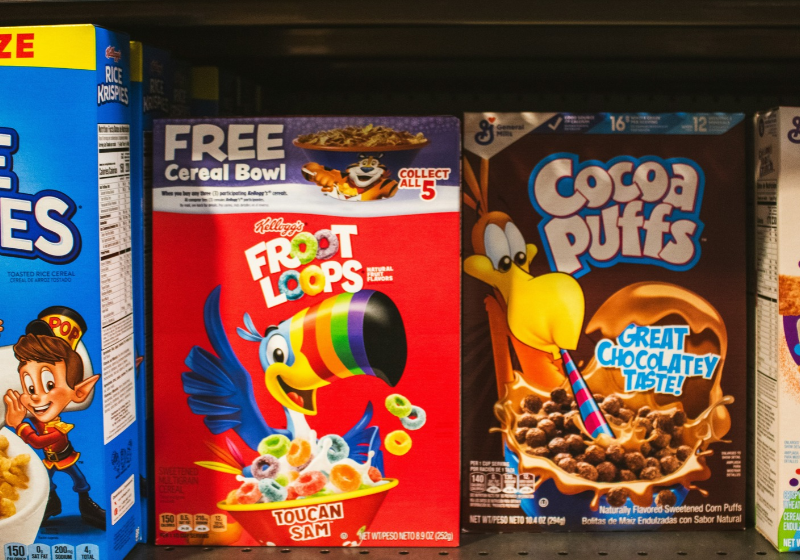
Many high sugar products aimed at children use cartoon characters, bright colours and playful designs to attract attention, increase demand and present as appropriate options to parents.
Even at breakfast, many products marketed towards children contain surprisingly high levels of sugar. Recent studies found 96% of breakfast cereals were high or medium in total sugars, while only 1 in 40 yoghurts were suitably low in sugars.
Promotional offers, such as free toys, collectables, competitions and TV advertisements can also encourage children to favour specific brands. Since January 2026, adverts for less healthy food and drink are unable to be broadcast on television before 9pm, aiming to curb children’s exposure. However, loopholes have already weakened the restriction, with many categories excluded and brand-level advertising still allowed, meaning well recognised brand logos and jingles are still able to be shown even if most products from that brand are deemed unhealthy.
Food industry vs the teenage years
As children become teenagers and gain more independence, food marketing follows them into digital spaces. Research from Bite Back found that four out of every five social media posts from major out-of-home businesses contained content likely to appeal to young people. Brands also build loyalty through influencer partnerships and sponsorship deals with major sporting organisations. One study found over 90 high fat, salt, sugar (HFSS) brand partnerships with top British sporting teams, including Cadbury and PepsiCo.
The physical environment around teenagers also shapes food choices. An estimated 63% of outdoor food advertising is for less healthy foods, as one Essex-based investigation found 45 schools in the area had at least one unhealthy food advert less than 400m away. Councils can also face intimidation by food companies when attempting to limit unhealthy food environments around schools.
With personalised digital advertising, viral online food trends and the rise of easy access to fast food outlets via delivery apps, policies designed to improve the food environment are forever trying to catch up with the expanding array of ways the food industry creates loopholes and markets to our children.
What’s the solution?
Food industry influence – and by extension, high sugar foods – infiltrate every aspect of children’s lives, but this is not inevitable. While parents can help by encouraging lower sugar options and building healthy habits at home, the burden should not solely fall on parents to navigate a food environment stacked against them.
Local authorities have an important role to play through healthier advertising policies, planning measures that limit unhealthy food environments around schools, and support for healthier food provision in public spaces, including early years settings. National government must also strengthen existing regulations by closing loopholes in advertising restrictions, ensuring baby food standards are robust and enforceable, and introducing meaningfully healthy food targets with transparent monitoring and reporting so progress can be measured and accountability maintained.
These are just some of the actions needed. Improving children’s health will require coordinated action from government, local authorities, schools, businesses and communities. If we are serious about reducing health inequalities and giving every child the best start in life, we must create food environments that put health before profits and make the healthy choice the easy choice for all. After all, a healthy generation benefits everyone.
Read Action on Salt & Sugar’s latest report into Sweet Spreads.
Author Bio:
Zoe Davies is a Senior Nutrition Projects Officer at Action on Salt and Sugar (AoSS) based at Queen Mary University of London. Zoe advocates for a healthier food environment to improve public health. This is achieved through independent monitoring of the food sector to encourage food and drink reformulation, working alongside relevant stakeholders to campaign for change and responding to key government consultations to influence policy.
